Generic filters
FS Logoi

European nonwovens production decreased again

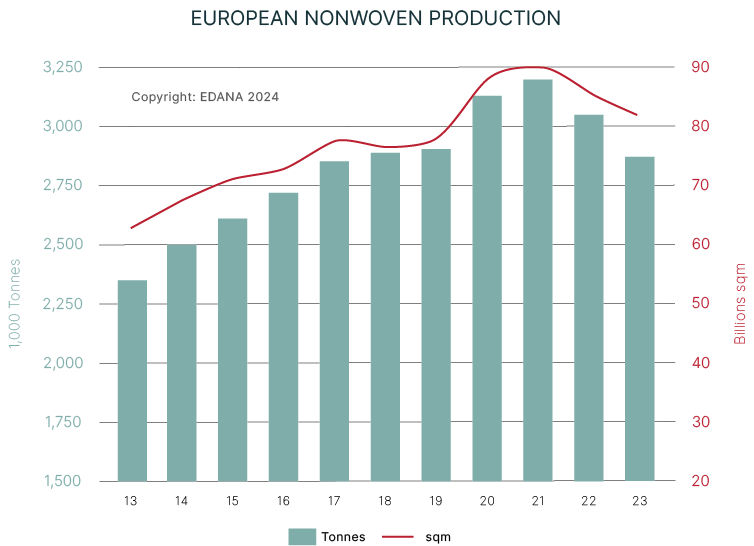
In 2023, compared to data from 2022, nonwovens production in Greater Europe decreased in volume by 5.7% to 2,864,840 tonnes, and by 5.5% in surface area. This is outlined in the EDANA Statistics Report on Nonwovens Production and Deliveries for 2023.

von | 17.04.24

Some segments, such as hygiene, medical (excluding face masks), building construction, filtration, and electronic materials significantly decreased.
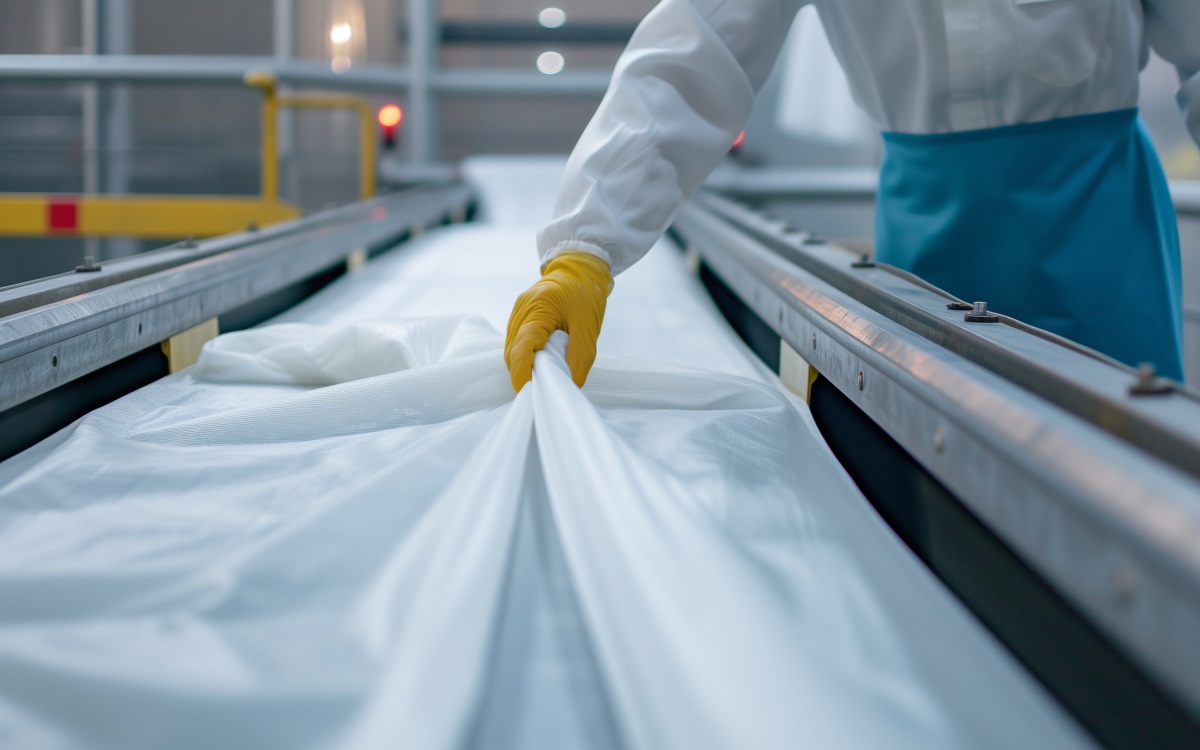
Source: studioworkstock /AdobeStock
Nonwovens
17.04.2024 Ι In 2023, compared to data from 2022, nonwovens production in Greater Europe decreased in volume by 5.7% to 2,864,840 tonnes, and by 5.5% in surface area. This is outlined in the EDANA Statistics Report on Nonwovens Production and Deliveries for 2023.

Differentiation by production process

Jacques Prigneaux, EDANA’s Market Analysis and Economic Affairs Director, further expanded on the data: “European nonwovens production recorded its second consecutive decline since it peaked in 2021, however, it is necessary to refine the data further and assess the trends according to the different production processes. For drylaid, the production of thermally and chemically bonded nonwovens both demonstrated a double-digit decline. The production of polymer-based nonwovens decreased again, but remained above its 2019 level, despite a severe decrease in meltblown stand-alone materials. Meanwhile some production processes, such as drylaid-hydroentangled and short-fibres airlaid, stayed flat or slightly above their respective levels for the previous year.
European Nonwovens Production Decreased AgainNonwovens: not all segments are affected equally

Analysing 2023 sales data by market segments leads to a different conclusion: Some segments, such as hygiene, medical (excluding face masks), building construction, filtration, and electronic materials significantly decreased compared to their 2022 levels, but were either at the same level as or above figures observed in 2019.

Overall, the wipes’ market, including personal care, industrial, and household segments, was stable (+0.9%). There were some noticeable exceptions in other applications, where nonwovens sales recovered: automotive interiors (+3.7%), agriculture (+7.7%), table linen (+4.2%), cotton pads (+6.8%), personal protective garments (+10%) and packaging (+9.5%).”
More data presented at the EDANA Innovation Forum

The data is not shared externally, however, Prigneaux will present an overview of the key findings at the inaugural EDANA Innovation Forum in Munich, Germany in June 2024. In the meantime, a summary report – 2023 European Nonwovens Markets Insights – will be made available soon for EDANA members.


More Information

Bildquelle, falls nicht im Bild oben angegeben:

Jetzt Newsletter abonnieren

Immer auf dem aktuellen Stand, alle 2 Wochen in Ihrem Postfach.

Hier anmelden

Rezyklate für Geotextilien

Im Projekt GREEN hat der Fraunhofer-Cluster of Excellence Circular Plastics Economy (CCPE) untersucht, wie sich Rezyklate zu Geotextilien verarbeiten lassen. Die Ergebnisse zeigen, dass recycelte Kunststoffe die Anforderungen industrieller Anwendungen erfüllen können.

mehr lesen
Powtech 26: Lösungen für das Pulverhandling

De Dietrich präsentiert auf der POWTECH TECHNOPHARM 2026 integrierte Systeme für die Fest-Flüssig-Trennung, Trocknung, Produktrückgewinnung und den geschlossenen Pulvertransfer. Das Unternehmen zeigt Lösungen für den gesamten Produktionsprozess – von Pilotversuchen bis zur industriellen Produktion.

mehr lesen
Separator für hochdichte Fermentationsbrühen

Alfa Laval erweitert sein Portfolio um den Separator Culturefuge 200 B. Das System ist für die kontinuierliche Separation hochdichter Fermentationsbrühen in biopharmazeutischen Prozessen ausgelegt und richtet sich insbesondere an Produktionsanlagen im mittleren Maßstab.

mehr lesen
EU-Projekt entwickelt Verfahren zur CO2-Nutzung

Das EU-geförderte Forschungsprojekt REACT entwickelt unter Beteiligung der Empa ein elektrochemisches Verfahren, mit dem industrielle CO₂-Emissionen in Ethylen umgewandelt werden sollen. Ziel ist es, fossile Rohstoffe in der chemischen Industrie teilweise zu ersetzen und Kohlenstoffkreisläufe zu schließen.

mehr lesen
Workshop zu biobasierten Polymeren

Der Fraunhofer Cluster of Excellence Circular Plastics Economy (CCPE) veranstaltet am 15. September 2026 auf dem Dechema Forum in Frankfurt einen Workshop zu biobasierten Polymeren. Im Mittelpunkt stehen deren Potenziale für die Kreislaufwirtschaft sowie der Transfer in industrielle Anwendungen.

mehr lesen

Sie möchten die F&S Filtrieren und Separieren testen?

Bestellen Sie Ihr kostenloses Probeheft

Überzeugen Sie sich selbst: Gerne senden wir Ihnen die F&S kostenlos und unverbindlich zur Probe!

Finance Illustration 03