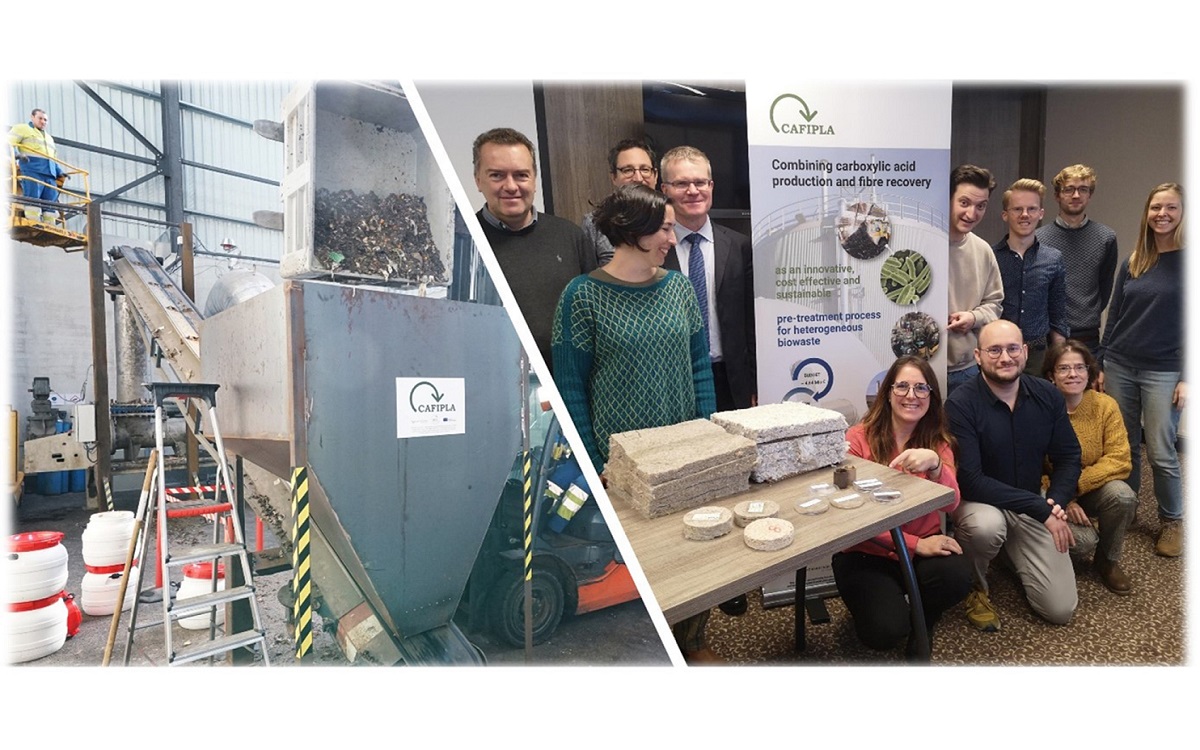
09.05.2023 Ι In the CAFIPLA project, 12 partners from across Europe, including six SMEs, are taking up the challenge of developing a new integrated platform for the economic conversion of biowaste into higher value products. They are supported by research institutes, universities, and industrial companies. As one of the project partners, DECHEMA, a non-profit professional society and the expert network for chemical engineering and biotechnology in Germany, developed the present CAFIPLA Guideline, which is available for free on the CAFIPLA website.
The CAFIPLA implementation guideline offers a comprehensive resource for stakeholders interested in successfully integrating biowaste recycling strategies for the creation of novel bioeconomic value chains. The guideline provides valuable insights into the CAFIPLA technology and highlights key factors to establish novel routes for biowaste valorisation on a regional level. The highly flexible CAFIPLA concept offers an innovative and economic alternative to existing technologies for biowaste utilisation, offers multiple implementation options and can thus be tailored to local requirements. Further upscaling of the concept and its transfer to future biowaste valorisation sites will be key to help unlock biowaste as a raw material for the European circular bioeconomy.
Creation of novel bioeconomic value chains
The growing demand for biomass to feed the production of biochemicals, bioenergy and biobased materials entails the potential for conflicts regarding e.g., its optimal use or sufficient supply. Biowaste will become increasingly relevant as abundant and sustainable bioresource to ease trade-offs between industrial and environmental interests and the competition for increasingly scarce bioresources.
Integrated biowaste valorisation strategy
The CAFIPLA technology offers an innovative, future-oriented, and economic solution for biowaste utilisation via an integrated biowaste valorisation strategy that combines a Carboxylic acid platform and a Fibre recovery platform to obtain industrially relevant platform products: (1) Specific spectra of carboxylic acids feed into the bioproduction of microbial protein, bioplastics or bio-oils while (2) recovered fibres are manufactured into biobased materials for packaging, insulation and construction applications. The CAFIPLA platforms are highly adaptable and can be tailored to specific local requirements by customising the value chains to go hand in hand with given feedstock supplies, stakeholders and markets. Different implementation routes, including an integration into existing biorefinery or waste treatment sites to complement existing biowaste utilisation approaches or the installation of stand-alone CAFIPLA biorefineries, additionally increase the technology’s application potential.
Implementation of the concept
The newly released “CAFIPLA Guideline for Successful Integration of the Technology Platform” outlines opportunities and challenges that must be considered in moving towards implementation of the concept. The requirements of the CAFIPLA technology are evaluated, considering supply chains and technical feasibility and highlighting the economic added value of the diverse biowaste-based end product portfolio. Based on an overarching PESTEL analysis clear recommendations are provided to accelerate biowaste valorisation and the circular transition. With roughly 20,000 biogas plants in Europe and an estimated potential of 17 million tonnes of biowaste available for anaerobic digestion , the extensive implementation potential of the CAFIPLA technology is evident. Next steps must address the scale up of the technology to unlock biowaste as a raw material for bioeconomic value chains.
Download the Guideline